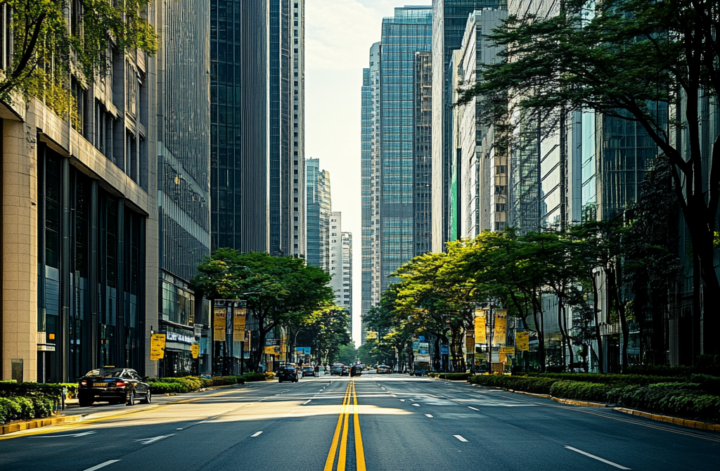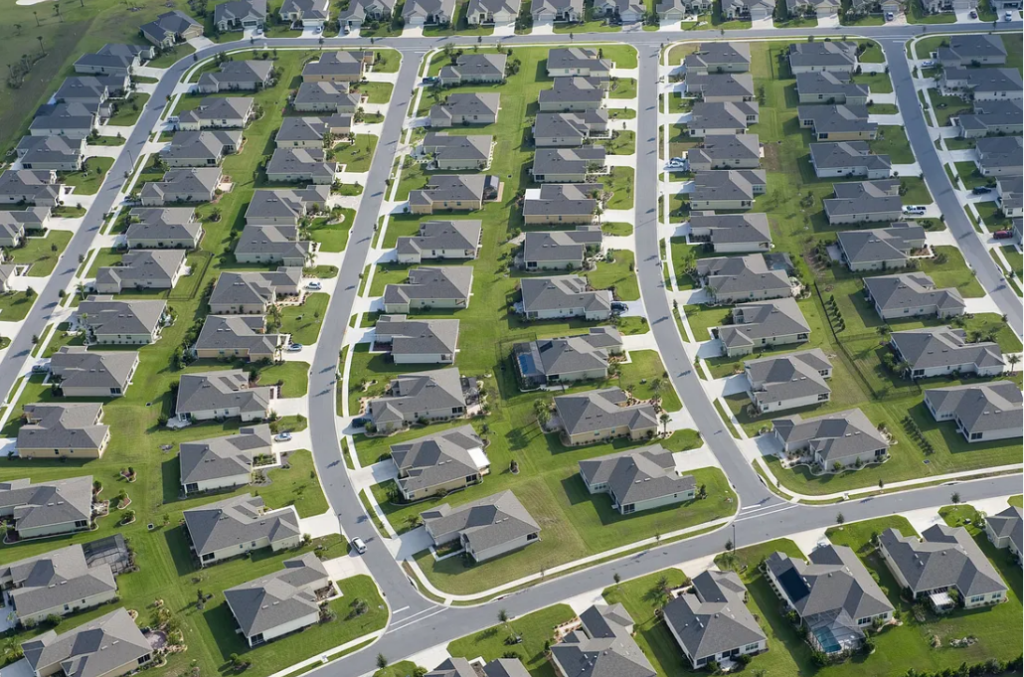
Traveling in Europe recently made me realize something interesting about American cities: We’ve tried to combine the country with the city with disastrous results.
America wanted to have it all with no limits. Open space. Fast traffic. Big yards. Highways. Quiet neighborhoods. Lots of stores and lots of jobs. When you combine all of them, you get the average American city. Miles of low-density R1 zoning that doesn’t even allow a corner cafe. Urban highways cutting through struggling (and often empty) downtowns filled with useless open space. Big box stores with huge parking lots. Suburbs with huge yards built on former farmland.
We’ve created Blandville.
Blandville: A term for American cities that, in trying to blend urban and rural ideals, end up with soulless, sprawling suburbs, overly wide streets, and dead downtowns, creating a monotonous, car-dependent landscape that’s neither vibrant city nor charming country.
A few of the components of Blandville are pretty well known, but lets go into them in detail.
Stroads
You’ve seen pictures of them everywhere. Traffic engineers tried to combine country roads and local access streets. Charles Marohn called them stroads. The result was a Frankenstein hodgepodge of fast, ugly roads where through traffic and slower, local traffic conflict.
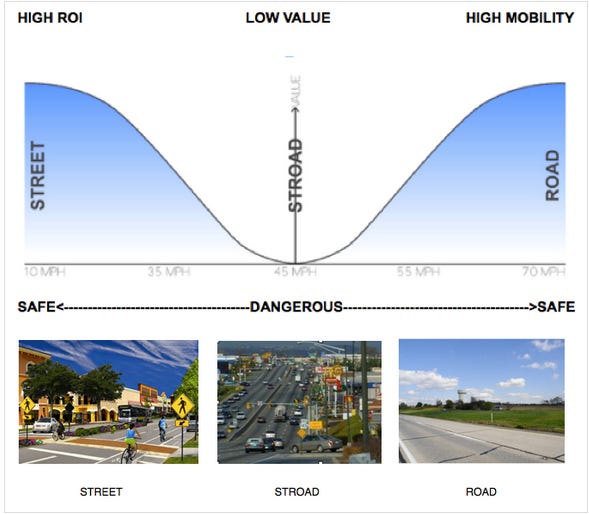
Putting major retailers and hundreds of curb cuts on corridors designed as through streets was a bad idea. Unfortunately, they’re everywhere now.
These roads lack the charm and bucolic beauty of country roads, and the streetlife and energy of urban streets. We tried to have it all, but got nothing. In fact, we got less than nothing, as stroads often have incredibly high rates of roadway injuries and fatalities. They’re also pretty ugly as far as infrastructure goes.
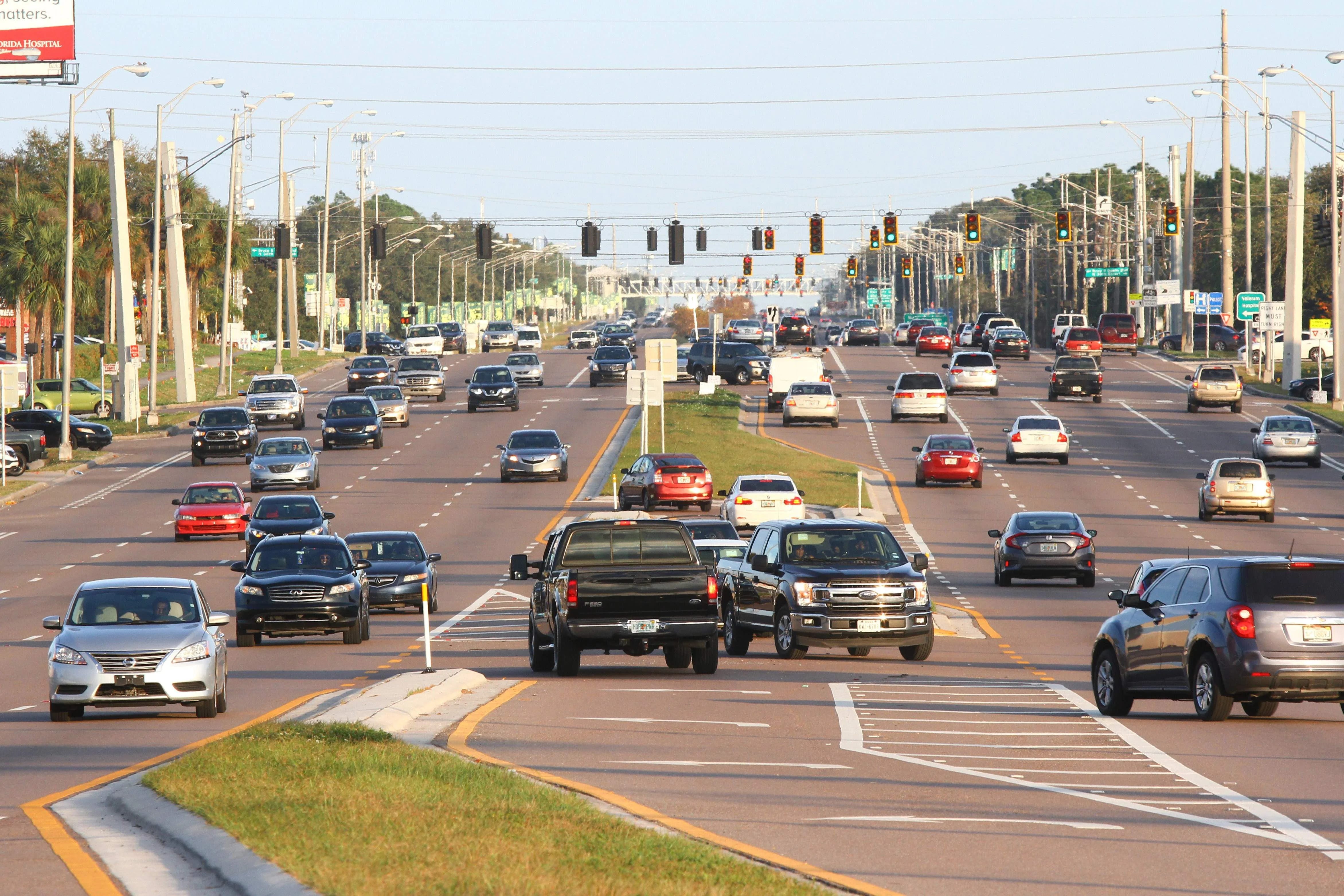
Neither urban or rural, they exist in a sort of gray area where people are trying to escape the city, yet still want all the commercial and retail choices of a city. Having your cake and eating it too isn’t a winning combination.
American Suburbs
Yes, there is always a market for suburban housing, and living just outside of a city is a perfectly reasonable choice. But the way American suburbs are designed leaves a lot to be desired. I attribute it to planners and developers trying to combine the country with the city and creating a weird, isolating hodgepodge that’s pretty unique to America.
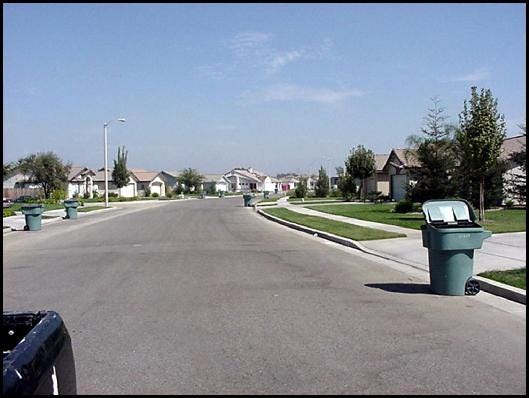
Lots of open space, but most of it is useless (huge front yards) or paved over (excessively wide streets). The farmland is gone, so the neighborhood can’t really be described as “country”, but since corner cafes or any kind of retail/commercial is banned through zoning, the livability and convenience benefits of cities is also negated. It’s not country. It’s not the city. It’s also not a charming small town where you would run into your neighbor at the market square. They were also created with massive FHA and FHWA subsidies and outright federal spending. Not that there’s anything wrong with that, but let’s not pretend that auto-centric American suburbs were conceived based on market demand or private spending.
Hollowed Out Downtowns
In St. Louis, 91 acres of land were demolished to make way for the Gateway Arch and the surrounding Jefferson National Expansion Memorial (now part of Gateway Arch National Park). This cleared 39 blocks of historic buildings and homes along the St. Louis riverfront in the late 1930s and early 1940s, a controversial process involving eminent domain that displaced thousands and leveled a vibrant urban neighborhood to create the open park grounds.
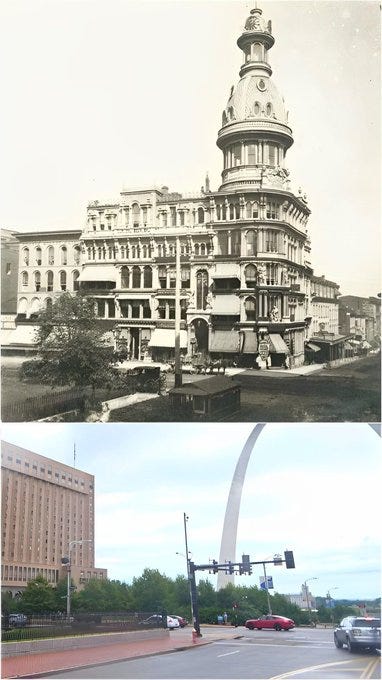
The riverfront neighborhood was replaced with suburban style office buildings with huge setbacks, excessive open space that’s mostly empty during the day, and highways. We tried to combine the city with country, but lost the charm of both.
This is one example of the Blandville-ication of American downtowns, but you can see it at a smaller scale all over the country: Excessive parking lots. Useless setbacks with ambiguous open space. Low density buildings encouraged through zoning that bring in 1/100th of the city revenue higher density projects would. Underutilized “parks” that are really just landscaping within building setbacks.
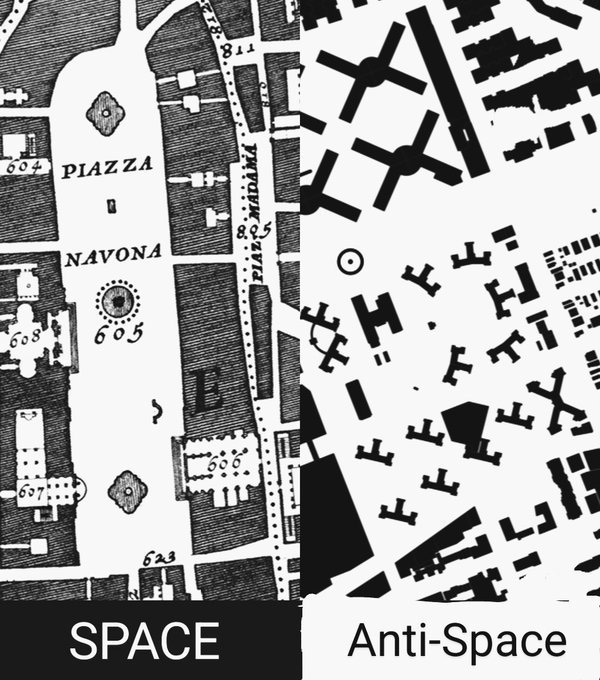
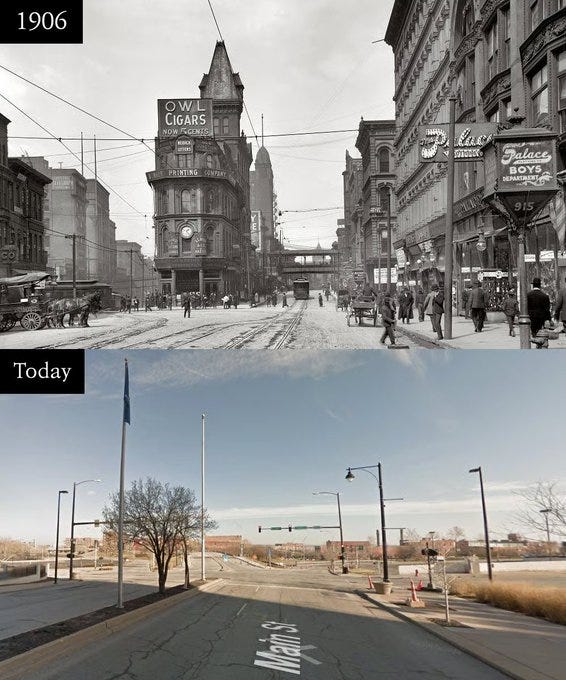
There’s often more underutilized open space and empty lots in American downtowns than there is in the suburbs. In trying to make urban areas more orderly and spacious like the countryside, we ruined what made them great: Their busyness, their density, and their diversity of building types.
The Tyranny of Parking
American cities didn’t just pave over their farmland for suburbs or their downtowns for highways. They paved over their potential for parking lots. Zoning codes across the country mandate minimum parking requirements, forcing developers to dedicate huge swaths of land to asphalt for cars, whether they’re needed or not. A strip mall needs 50 spaces for a coffee shop. An apartment building needs two spaces per unit, even if half the residents don’t own cars. The result? Urban spaces that feel like giant parking lots with buildings as an afterthought.
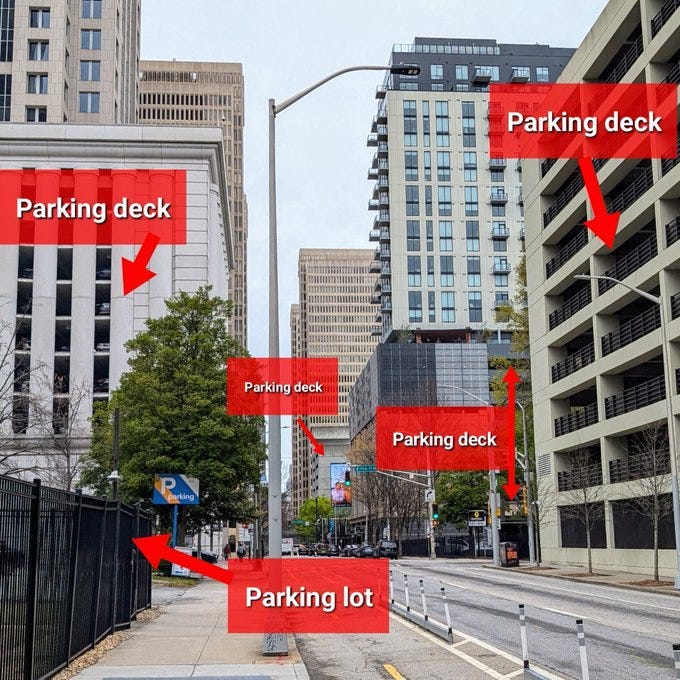
This obsession with parking is another attempt to blend the convenience of rural car travel with urban density, and it fails miserably. In the country, you need a car to get around. That’s fine. But in a city, mandating parking for every building turns walkable streets into car storage yards. It’s not just ugly; it’s expensive. Developers pass the cost of building and maintaining these lots onto renters, buyers, and taxpayers. In Blandville, you’re paying for parking you didn’t ask for, in a city that’s less livable because of it.
In some ways, American planning loves micromanaging the little things: 8 different facade treatments and 4 setbacks required for urban infill projects. Arbitrary FARs and height limits. Roads that are too wide because the fire department says so. Cafes aren’t allowed in suburban neighborhoods because reasons. Required parking lots are too big because some guy did a traffic study in 1974.
But on the other hand, American planning doesn’t like reasonable regulations at the regional level. Propose an urban growth boundary at a city commission meeting, and you’ll be laughed out of the room. Bring up densification around transit stops, and the NIMBYs will come out of the woodwork. Ask to study the reduction of parking requirements, and all hell will break loose. The planning profession has lost the plot. Planners no longer dream big, and they’re not encouraged to dream big, either. They’re expected to follow the rules and regulations written by other planners of a bygone era who seemed to hate cities, the countryside, or both. Their answer was to combine the country and the city so we could have the best of both worlds in one place. Unfortunately, it didn’t work out.
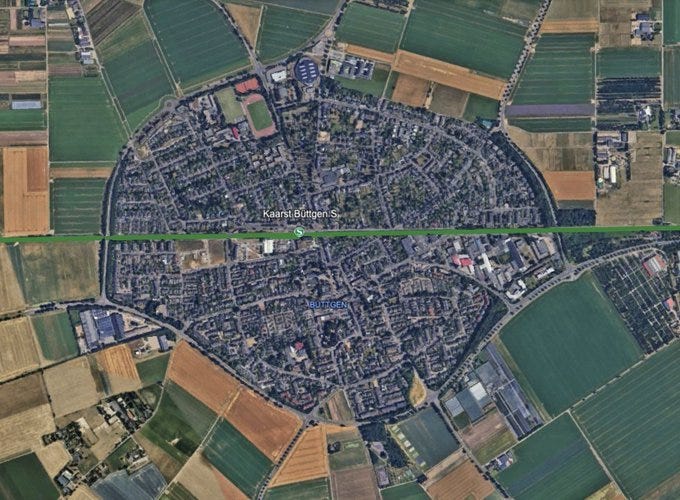
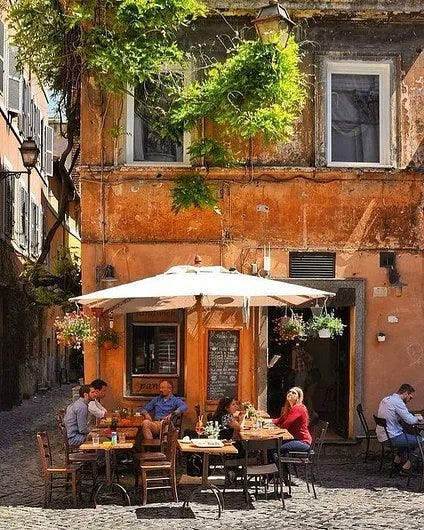
In the UK, I saw a lot of countryside. I also saw a lot of small towns and active downtowns. Everything in its proper place. In America, we’ve sold the countryside to private equity for more suburbs and hollowed out our most walkable places. It’s almost like the U.S. designed its cities specifically to maximize car sales. Maybe there’s some collusion going on?
The good news is that planners have the tools to undo Blandville and create places that feel alive, human, and connected. It starts with embracing clear boundaries between urban and rural, and realizing the value of both.
Urban growth boundaries, like those used in places like Portland, Oregon, can preserve farmland and countryside while encouraging denser, walkable cities. Planners can champion zoning reforms that allow mixed-use developments and higher densities within existing built-up areas. These changes can bring the convenience of urban life without sacrificing the quiet of the suburbs. When we build within our cities, we relieve the development pressure that consumes our farms and countryside. Unfortunately, there is a knee-jerk anti-city bias that many planners and politicians have, especially since many of them live in auto-centric suburbs and visit cities only during vacations. I believe this bias has held back a lot of progress, and I’m not sure the issue is solvable within our city planning profession. It is what it is.
But by putting people first and embracing bold visions, planners can transform Blandville into vibrant cities while preserving countrysides, where every street, square, and neighborhood feels unmistakably alive.
Enjoyed this article? Feel free to put some change in my tip jar. This article originally appeared on Substack.